
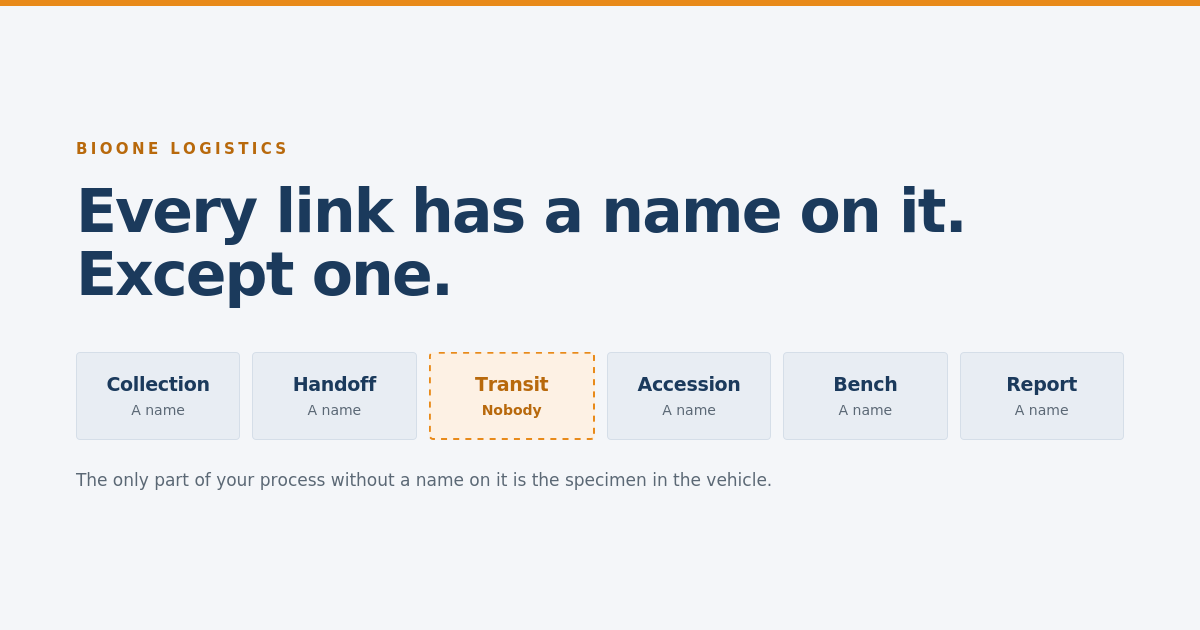
The one link in your chain of custody without a name on it
If you run a laboratory in Central Florida, you can account for a specimen almost perfectly.
It arrives. It gets an accession number. From that moment on, every hour is attributable — who received it, who processed it, who sat at the scope, who signed the report out. If someone calls three years from now with a question about a case, you can answer it.
Then there's the part before accession.
For that stretch, most labs have exactly three pieces of information: a pickup time, a delivery time, and a phone number for a dispatcher who wasn't in the vehicle. No temperature record. No signature at origin. No name.
It is the only link in the chain that can't account for itself — and it is the one where the specimen is least protected.
Accession is your first timestamp. Not the specimen's.
This is worth sitting with, because it's easy to miss.
Your accession number is the beginning of your record. It is not the beginning of the specimen's day. By the time you assign it, that sample may have been sitting on a counter at a physician's office since ten in the morning, ridden ninety minutes in a vehicle you know nothing about, and passed through hands nobody logged.
Everything you can prove starts at accession. Everything that can go wrong starts well before it.
What the gap actually costs
Three things, in ascending order of seriousness.
Turnaround you can't defend. When a referring physician calls to ask why a result is late, "the courier was late" is not an answer that helps you. They didn't hire the courier. They hired you.
Specimens that arrive compromised. Formalin has a tolerance. Whole blood has a tolerance. A sample that spends an August afternoon in a Florida vehicle without temperature control may be unusable on arrival — and without a temperature log, you cannot prove where it happened or that it wasn't you.
The specimen that can't be replaced. A surgical biopsy. A timed draw. A frozen section from a case where the patient is already closed. Recollection isn't always available, and when it is, the cost was never the specimen. It's the phone call to the physician, and where that physician sends the next one.
Who is actually driving
Worth knowing how the low-cost end of this market works.
Gig courier platforms draw from the same driver pool as food delivery. The person picking up a biopsy may have delivered a pizza an hour earlier — same vehicle, same insulated bag, no business associate agreement, and no idea what's in the box.
That isn't a slur on the drivers. It's a description of a business model. Those platforms optimize for utilization: whoever is nearest takes the stop. It's also why nobody at your front desk ever sees the same face twice.
National carriers are more professional and more expensive, but they run on the same principle. Dedicating a driver to one route means paying for idle time, and their cost structure doesn't allow it.
Four questions worth asking
Ask these of whoever moves your specimens today. Ask them of anyone bidding for the work, including us.
Can you show me the temperature log from an actual delivery last week? Not a brochure. A real record from a real run.
What is your documented procedure when a specimen arrives out of range? If there isn't one, that tells you what happens: nothing.
If I call at seven in the evening, does a person answer — and is it someone who can send a vehicle?
Will the same driver be on my route next month, and what happens when they're out? Listen for whether the answer is a name or a policy.
The standard, not the pitch
A courier is an extension of your laboratory. The physician's office doesn't experience two vendors; they experience one service, and the part they see most often is the person at the door.
So the question isn't really about logistics. It's whether the least visible link in your chain of custody is held to the same standard as every other one.
Everything after accession has a name attached to it. The leg before it should too.
BioOne Logistics is a locally owned medical courier serving laboratories, surgery centers and practices across Polk, Osceola, Lake and Orange counties. Every run carries continuous temperature monitoring and a signed chain of custody at both ends, and every route is assigned to one named person. If you'd like to talk about how your specimens move today, set up a time or call 407-635-1211.
If you run a laboratory in Central Florida, you can account for a specimen almost perfectly.
It arrives. It gets an accession number. From that moment on, every hour is attributable — who received it, who processed it, who sat at the scope, who signed the report out. If someone calls three years from now with a question about a case, you can answer it.
Then there's the part before accession.
For that stretch, most labs have exactly three pieces of information: a pickup time, a delivery time, and a phone number for a dispatcher who wasn't in the vehicle. No temperature record. No signature at origin. No name.
It is the only link in the chain that can't account for itself — and it is the one where the specimen is least protected.
Accession is your first timestamp. Not the specimen's.
This is worth sitting with, because it's easy to miss.
Your accession number is the beginning of your record. It is not the beginning of the specimen's day. By the time you assign it, that sample may have been sitting on a counter at a physician's office since ten in the morning, ridden ninety minutes in a vehicle you know nothing about, and passed through hands nobody logged.
Everything you can prove starts at accession. Everything that can go wrong starts well before it.
What the gap actually costs
Three things, in ascending order of seriousness.
Turnaround you can't defend. When a referring physician calls to ask why a result is late, "the courier was late" is not an answer that helps you. They didn't hire the courier. They hired you.
Specimens that arrive compromised. Formalin has a tolerance. Whole blood has a tolerance. A sample that spends an August afternoon in a Florida vehicle without temperature control may be unusable on arrival — and without a temperature log, you cannot prove where it happened or that it wasn't you.
The specimen that can't be replaced. A surgical biopsy. A timed draw. A frozen section from a case where the patient is already closed. Recollection isn't always available, and when it is, the cost was never the specimen. It's the phone call to the physician, and where that physician sends the next one.
Who is actually driving
Worth knowing how the low-cost end of this market works.
Gig courier platforms draw from the same driver pool as food delivery. The person picking up a biopsy may have delivered a pizza an hour earlier — same vehicle, same insulated bag, no business associate agreement, and no idea what's in the box.
That isn't a slur on the drivers. It's a description of a business model. Those platforms optimize for utilization: whoever is nearest takes the stop. It's also why nobody at your front desk ever sees the same face twice.
National carriers are more professional and more expensive, but they run on the same principle. Dedicating a driver to one route means paying for idle time, and their cost structure doesn't allow it.
Four questions worth asking
Ask these of whoever moves your specimens today. Ask them of anyone bidding for the work, including us.
Can you show me the temperature log from an actual delivery last week? Not a brochure. A real record from a real run.
What is your documented procedure when a specimen arrives out of range? If there isn't one, that tells you what happens: nothing.
If I call at seven in the evening, does a person answer — and is it someone who can send a vehicle?
Will the same driver be on my route next month, and what happens when they're out? Listen for whether the answer is a name or a policy.
The standard, not the pitch
A courier is an extension of your laboratory. The physician's office doesn't experience two vendors; they experience one service, and the part they see most often is the person at the door.
So the question isn't really about logistics. It's whether the least visible link in your chain of custody is held to the same standard as every other one.
Everything after accession has a name attached to it. The leg before it should too.
BioOne Logistics is a locally owned medical courier serving laboratories, surgery centers and practices across Polk, Osceola, Lake and Orange counties. Every run carries continuous temperature monitoring and a signed chain of custody at both ends, and every route is assigned to one named person. If you'd like to talk about how your specimens move today, set up a time or call 407-635-1211.